REVIEW · ISLAND HIGHLIGHTS & SIGHTSEEING TOURS
Private Half-Day Sightseeing Tour of Santorini
Book on Viator →Operated by KALLISTI TOURS · Bookable on Viator
Santorini makes sense with a private road map. This private half-day tour strings together the island’s volcanic highlights—Oia, Red and Black Beaches, Akrotiri, and an optional winery—in a customizable route you shape around your interests and your chosen start time. I especially like the door-to-door pickup and the one-on-one pacing, which keeps photo stops and questions from turning into a scramble. The one watch-out: it’s only 4 to 6 hours, so any add-ons with extra fees (like Akrotiri entrance or wine tastings) can affect how much time you get at each stop.
The guides on this kind of tour really matter, and the strongest signals here are names like Theodore, Tomas, and Michael—people who worked hard to use time well and get you to the best angles. In one highlight, a guide even flagged uneven pavement so you could move around safely. You also travel in a private air-conditioned European-sized vehicle, which is a big deal in Santorini’s heat.
In This Review
- Quick takeaways
- The value in a custom, private route (not just a checklist)
- Getting picked up smoothly: cable car upper station, ports, and hotels
- Three Bells of Fira and Firostefani: a quick start with big-photo payoff
- Oia for the iconic caldera views (and time to slow down)
- Imerovigli viewpoints: Skaros Rock and a calmer pocket
- Red Beach and Perissa/Perivolos Black Sand: the volcano made visible
- Profitis Ilias Monastery: the highest viewpoint stop
- Traditional villages without the big-tour crush: Megalochori and Pyrgos Kallistis
- Akrotiri ruins: Pompeii of the Aegean energy, with real logistics
- Emporio windmills and the Akrotiri lighthouse: a quieter, scenic finish
- Winery time: Santo Wines, Art Space, or Koutsogiannopoulos (and what to budget)
- The guides: why names like Theodore and Tomas show up often
- How to decide if this tour fits you (and when it might not)
- FAQ
- How long is the private half-day Santorini sightseeing tour?
- Is this tour private or shared with other groups?
- Can I choose when the tour starts?
- Where does pickup happen on Santorini?
- What’s included in the price?
- What’s not included?
- Are wine tastings included?
- What about Akrotiri—does the guide walk with you inside?
- What language is the tour guide?
- Is there free cancellation?
Quick takeaways
- Choose your start time and fine-tune the day as you go
- Oia + volcanic beaches + Akrotiri in one efficient half-day route
- Private, air-conditioned vehicle means less waiting, more seeing
- Akrotiri stop includes entry guidance, but you’ll explore inside on your own with official rules
- Winery options at the end let you pick your style of tasting
- Short duration can feel full-throttle, so pick what matters most
The value in a custom, private route (not just a checklist)
Santorini’s “highlights” are famous for a reason—Oia views, the black-sand beaches, and Akrotiri’s Bronze Age ruins—but doing them with buses and crowds can turn your day into a game of hurry-up-and-wait. This tour’s main advantage is that it’s private and built to be adjusted. You meet your guide at your accommodation (or port/airport), then set the rhythm from there.
Price is $199.55 per person, which is not cheap, but you’re paying for something you can’t replicate as easily on your own: a driver who knows how to string stops together, plus a guide who can shift priorities when you want more time somewhere or less time somewhere else. The included bottled water also sounds small, but after a few hours on the road, it matters.
What you don’t get in the base price is the “extra layer” costs: entrance fees at optional sites and any wine tasting fees. Tips are recommended, and food isn’t included. If you go in knowing those are real costs, the whole day feels more balanced.
You can also read our reviews of more private tours in Santorini


Getting picked up smoothly: cable car upper station, ports, and hotels
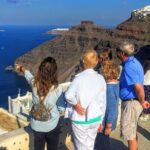
The pickup plan is clear, which helps on a tight half-day. If you’re arriving by cruise, the meeting point is at the top of the cruise port cable car (upper station). Your guide will be holding a sheet with the lead passenger’s name. If you’re coming through Athinios ferry port, pickup happens at the arrivals terminal, and if you’re using Santorini airport (JTR), pickup is at the arrivals terminal as well.
If you’re staying on the island, hotel pickup is available. You also get a mobile ticket, which helps if you’re juggling a lot of moving parts that day.
Practical tip: when you confirm your day, ask your guide (or operator) to confirm the exact pickup point and time, especially if you’re on a ship with tenders. The goal is to avoid losing minutes to confusion.
Three Bells of Fira and Firostefani: a quick start with big-photo payoff
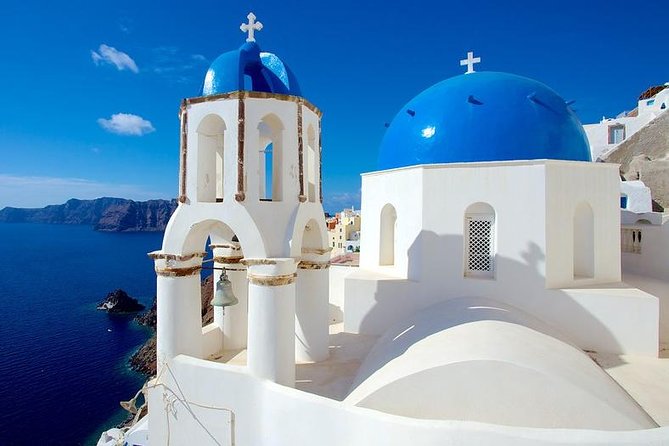
One early stop is in the Firostefani area for the view tied to the Three Bells of Fira. This is a short window (about 10 minutes) but it’s a classic Santorini “starter shot.” You’ll stroll through charming alleys toward a famous blue-domed church view—one of those images people picture instantly when they think of Santorini.
Why it’s worth it: it’s early enough that you’re not as deep into the day’s heat and timing pressure, and it gives you a strong sense of how the cliffs and caldera overlook work. The downside is obvious: this is not a long walk or a sit-down stop. If you want a deep, slow photo session, you’ll need to tell your guide you’d like extra minutes here.
Oia for the iconic caldera views (and time to slow down)
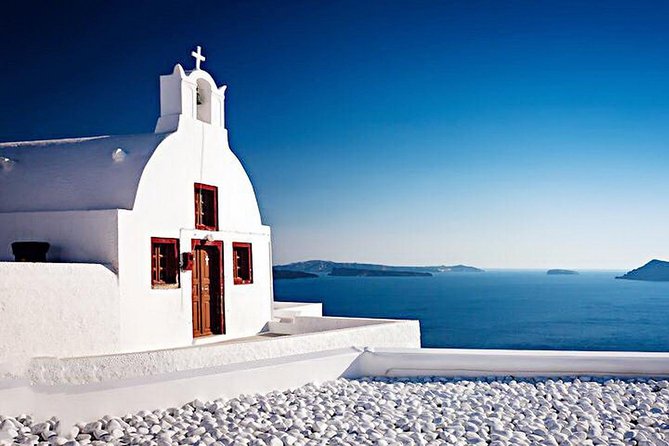
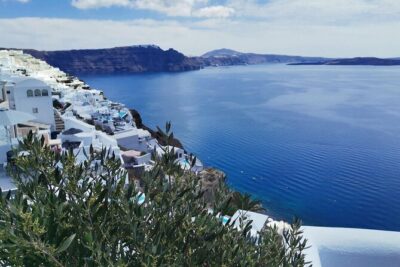
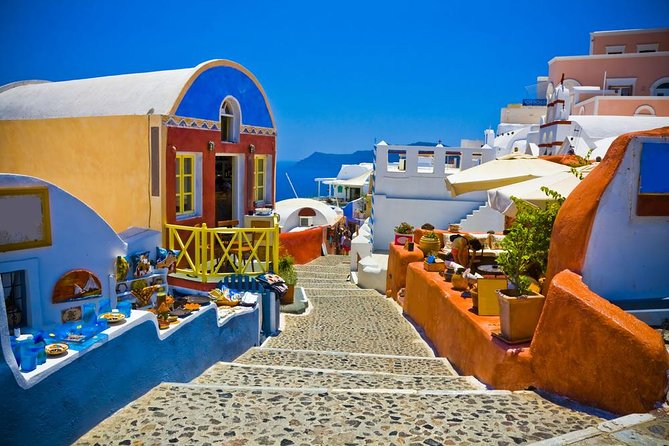
Next comes Oia—about an hour. Oia is where the whitewashed buildings and blue domes cluster around the caldera edge, and it’s one of the easiest places to understand why Santorini gets so much attention. Your guide can also point you toward good photo angles so you’re not stuck fighting foot traffic right in the busiest spots.
The best way to use this hour: don’t treat it like a checklist. Pick a viewpoint, then let yourself wander a bit. Oia rewards small detours—side streets, short stairways, and sudden turns that reveal layered views.
The caution: Oia is a magnet. Even with a private tour, you’ll still be dealing with the island’s most popular village energy. If you’re the type who hates crowds, ask your guide to favor quieter lanes and viewpoints, not just the postcard front.
Imerovigli viewpoints: Skaros Rock and a calmer pocket
After Oia, there’s a short pause in Imerovigli (around 15 minutes). Imerovigli sits at one of the highest and most central parts of Santorini’s caldera, so the payoff is panoramic. You’ll be able to look toward the volcano and Skaros Rock from a vantage that often feels more restful than the busiest caldera streets.
This stop is a breather stop in the best sense: it gives you a different angle without requiring a lot of transit or long walking. It’s also a good place to reset—water, quick photos, and getting your bearings for the south side of the island.
If you want fewer “move every 20 minutes” stops, this one is the easiest place to request a little extra time, since it’s built around viewpoints rather than shopping streets.
You can also read our reviews of more tours and experiences in Santorini






Red Beach and Perissa/Perivolos Black Sand: the volcano made visible
Then you get the volcanic coastline contrast. First, Red Beach with about 10 minutes, usually a viewpoint-style stop where you can take in the red cliffs and striking red sand tones. You may not have time to do an extended down-to-the-beach hike during a half-day tour, so consider this a “look closely from near the coast” window. If walking down to the sand is a must for you, tell your guide early so the schedule can flex.
After that, you’ll head to Perissa–Perivolos Black Beach for about 55 minutes. This is more substantial time, and it’s where you can actually relax by the sea. The black sand is the headline, but you also get practical benefits: there are seaside restaurants and beach bars along the stretch, and you’ll have enough time to swim or at least cool off in the water if you want.
How to plan your time here:
- If you want photos and a quick swim, keep your swim short and your clothing plan simple.
- If you care most about soaking up the beach vibe, use most of the 55 minutes for that and skip extra “shopping” stops.
This section is usually where the day shifts from “sightseeing” to “Santorini feels real.” That shift is the whole point.
Profitis Ilias Monastery: the highest viewpoint stop
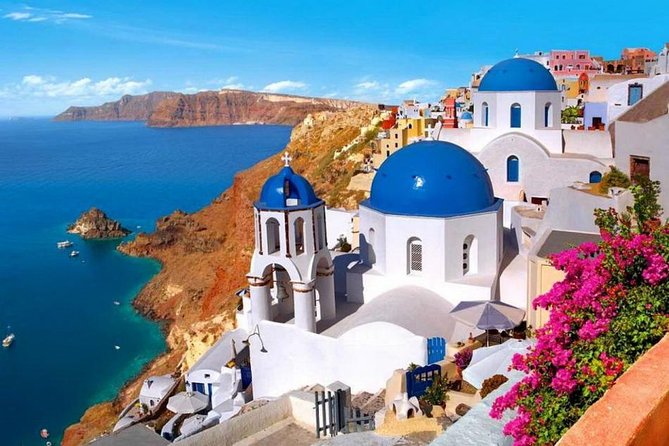
At around 15 minutes, the Monastery of Profitis Ilias stop uses Santorini’s highest hill—about 567 meters above sea level. From the summit you get wide-open Aegean views, and you’ll also have the chance to explore a Greek Orthodox chapel.
There’s often local product sampling connected to the monastery (handmade items crafted by the monks), plus a chance to hear Byzantine music. Even if you don’t plan on buying anything, it’s one of the few stops that adds culture and sound to the visual-heavy day.
The trade-off: it’s another climb, and if your day is already packed with stairs and viewpoints, you may want to pace yourself. Wear good shoes, especially if the pathways look smooth but are uneven.
Traditional villages without the big-tour crush: Megalochori and Pyrgos Kallistis
Two “island interior” style stops add texture to the day. Megalochori is a traditional village stop (about 15 minutes) with white-painted houses, narrow alleys, blue-domed chapels, and underground cave houses. It’s described as more non-touristic, which usually means it feels calmer and more lived-in.
Then there’s Pyrgos Kallistis (about 15 minutes), known as one of the island’s oldest villages and famous for a 16th-century Venetian castle. Expect a maze-like village layout with narrow alleys and defensive-style road design, which makes it fun to wander even in a short window.
Why these stops work: they remind you that Santorini isn’t only caldera views. You get architecture, older layouts, and a sense of village life beyond the postcard streets.
The drawback: these are short stops, so you won’t get a full “wander for hours” experience. If you love history and slow walking, you can ask to cut one of the viewpoint time slots to give yourself more village minutes.
Akrotiri ruins: Pompeii of the Aegean energy, with real logistics
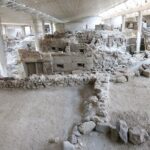
Akrotiri Archaeological Site is the big academic-style stop (about 30 minutes in the schedule), and it’s famous as the Bronze Age settlement buried by a volcanic eruption around 1600 BCE. The site is often compared to the Pompeii of the Aegean because buildings and frescoes are well preserved, and you can see evidence of advanced infrastructure.
Here’s the key practical rule: at Greek ancient sites, local drivers aren’t permitted to guide you inside. So your driver can drop you at the entrance, but you explore on your own with the information available on-site. The entrance fee is paid on-site and isn’t included.
How to get the most in a 30-minute window:
- Decide early what you want most: frescoes, building layout, or overall eruption story.
- If there are signs you can’t read quickly, take a photo so you can zoom later.
- Don’t try to see everything if it’s crowded. Pick a few zones and do them well.
If Akrotiri matters most to you, it’s worth planning your day so you don’t rush out of there just to hit another viewpoint photo spot.
Emporio windmills and the Akrotiri lighthouse: a quieter, scenic finish
On the way back, you may stop at the Windmills of Emporio (about 10 minutes). The view from the hilltop above Emporio can be gorgeous, with eight traditional windmills and a small whitewashed chapel nearby. It’s also a good photography spot, especially when the light turns warmer later in the day.
Then there’s an optional stop at the Akrotiri Lighthouse (about 15 minutes), dating to 1892. You’ll see the square-shaped tower rising over 10 meters above the former warden’s house, perched along the edge of the island. It’s not a long stay, but it gives you a calmer mood shift from villages and beaches.
These two stops can be a great way to end the day because they offer wide views without requiring a lot of effort.
Winery time: Santo Wines, Art Space, or Koutsogiannopoulos (and what to budget)
Most versions of this tour finish at a local winery, but there are multiple winery options. You might stop at Santo Wines Winery (about 45 minutes), where you can do wine tasting focused on Santorini’s volcanic soil and local varietals. Another option is Art Space Winery, an art center in a historic 1861 winery carved into pumice rock, with the chance to taste four wines alongside contemporary Greek art displays (about 30 minutes). There’s also the Wine Museum Koutsogiannopoulos in a cave-like space showing wine production history and offering tastings in a designed room (about 30 minutes).
Wine tasting fees are not included in the tour price, so budget extra if you want tastings rather than just a look. If you have a strong preference—say, you only want a specific winery—tell your guide before you’re on the road so the end of the day doesn’t get squeezed.
One honest consideration from real-world experiences: if time gets tight, the winery visit can be the first thing that gets cut. If wine is a priority for you, make it part of your plan early and keep your must-see list short enough to protect that last stop.
The guides: why names like Theodore and Tomas show up often
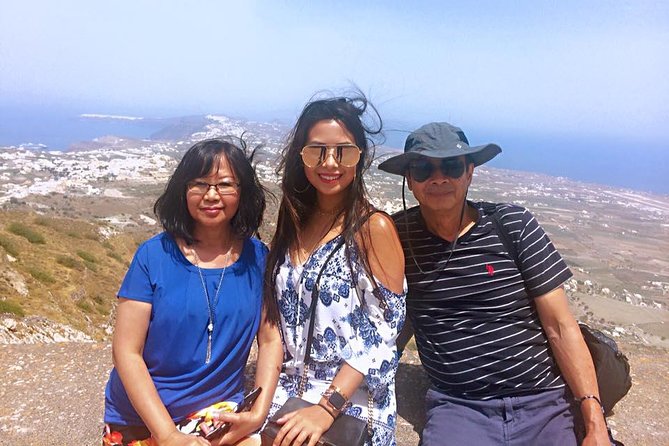
The strongest pattern in the feedback is that the guides treat the day like your day. People like Theodore are described as attentive, proactive about safety, and efficient with timing, including taking photos for you at key moments. Tomas is described as excellent for photo stops and knowing the best angles. Michael gets credit for sharing lots of useful detail and doing it in a professional way.
You can also get helpful extras, like being steered toward a favorite local restaurant for lunch. One example called out a stop at Agelos Steak House, plus a guide who made time for it. Even if you don’t eat the same place, the takeaway is important: with a private tour, you can ask for real local recommendations rather than guessing from a map app.
How to decide if this tour fits you (and when it might not)
You should book this private half-day tour if:
- You want a lot of Santorini in a short window without renting a car.
- You care about the big icons (Oia, beaches, Akrotiri) but want a day designed around your pace.
- You like photo stops and want someone to help you land in the right place at the right time.
- Your comfort depends on air-conditioned transport and a driver handling the route.
You might skip it if:
- You’re the type who wants a slow, wandering day with long stays in only one area.
- You hate any extra costs (entrance fees and wine tastings) and prefer a strictly fixed budget.
- You need a deep guided explanation inside Akrotiri. On this kind of tour, the official access rules mean your driver can’t guide inside; you’re exploring there on your own.
If you’re trying to pick between priorities, I’d treat Akrotiri and the beach time as the anchors. Use Oia and the viewpoints as your “wow moments,” then protect whichever part of the day matters most.
FAQ
How long is the private half-day Santorini sightseeing tour?
It runs about 4 to 6 hours.
Is this tour private or shared with other groups?
It’s private. Only your group participates.
Can I choose when the tour starts?
Yes. You choose your departure time to meet your private guide at your accommodation.
Where does pickup happen on Santorini?
Pickup is available from your hotel/accommodation, and also at the cruise port (top of the cable car/upper station), Athinios ferry port (arrivals terminal), and Santorini airport JTR (arrivals terminal).
What’s included in the price?
Included features are bottled water, a private guide/driver, hotel/port/airport pickup and drop-off, and transport in a private air-conditioned European-sized vehicle.
What’s not included?
Entrance fees at museums and optional sites are not included, tips are not included, and food and drinks are not included.
Are wine tastings included?
Wine tasting fees are not included. They’re paid separately at the winery, when the winery stop is chosen.
What about Akrotiri—does the guide walk with you inside?
Your driver can drop you at the entrance, but local drivers aren’t permitted to guide you inside. You explore the site at your leisure, and the entrance fee is paid on-site.
What language is the tour guide?
The tour is offered in English.
Is there free cancellation?
Yes. You can cancel up to 24 hours in advance for a full refund.