REVIEW · AKROTIRI & ARCHAEOLOGICAL SITE TOURS
Private Guided Tour of Akrotiri Excavations in Santorini
Book on Viator →Operated by Touring with Kostas · Bookable on Viator
Akrotiri turns ruins into a real city. This private visit with Kostas makes the Bronze Age settlement feel clear, from volcanic preservation to everyday details like plumbing and storage. I especially like how the guide uses visual cues to help you spot what matters, not just what looks impressive. One thing to consider: the main site is outdoors and you’ll be walking on uneven ground, so bring the right shoes and pace yourself.
You’ll start at the Akrotiri entrance gate in Mesaria, get set up with a short orientation, then move into the excavations for a focused, discussion-friendly tour that fits your group’s pace. I like that the story stays grounded: urban planning, fresco themes, and religious symbolism all link back to how people lived, not just what archaeologists found. The only drawback is practical—this tour price doesn’t include site admission, plus there’s an extra €20 per person for fees and taxes.
In This Review
- Key highlights worth knowing before you go
- Why Akrotiri feels like Greek Pompeii
- Meeting at the Akrotiri entrance gate with a real orientation
- Akrotiri’s Bronze Age city plan, daily life, and social order
- Frescoes, religion, and the Atlantis connection
- Volcano ash preservation: why it matters when you stand there
- Price and what you’re really paying for
- Logistics that can make or break your visit
- Who should book this private Akrotiri tour with Kostas?
- Should you book it?
- FAQ
- How long is the private guided tour of Akrotiri?
- Is this tour private, and how many people are in a group?
- Is the Akrotiri admission ticket included in the price?
- What does the tour price include?
- What’s not included besides admission?
- Where do we meet for the tour?
- Is the tour in English?
- What about cancellation?
Key highlights worth knowing before you go
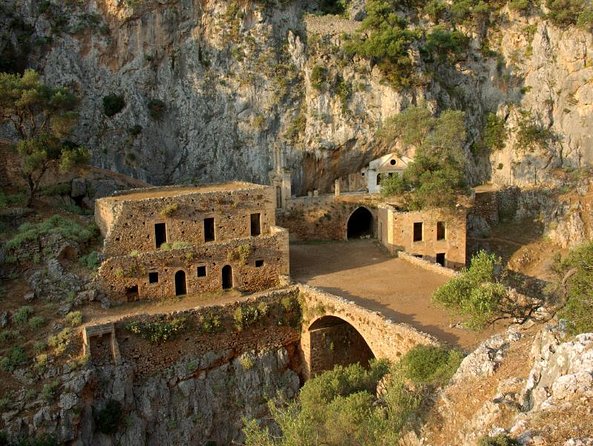
- Kostas-led private tour inside Akrotiri, built around interpretation and discussion
- Clear explanations of the city layout, daily life, and social structure
- Fresco art and symbolism, with themes tied to Bronze Age beliefs
- Hands-on sense of the site’s logic, from pottery to advanced plumbing systems
- Volcano-to-history storytelling, including why Akrotiri survived in ash
- Plato and Atlantis parallels, treated as a cultural connection, not a science claim
Why Akrotiri feels like Greek Pompeii
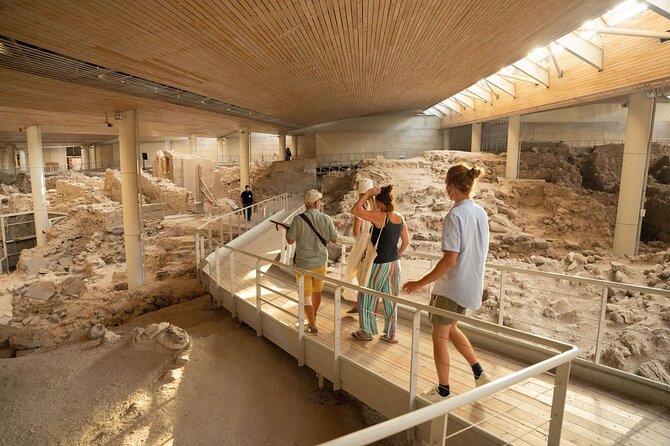
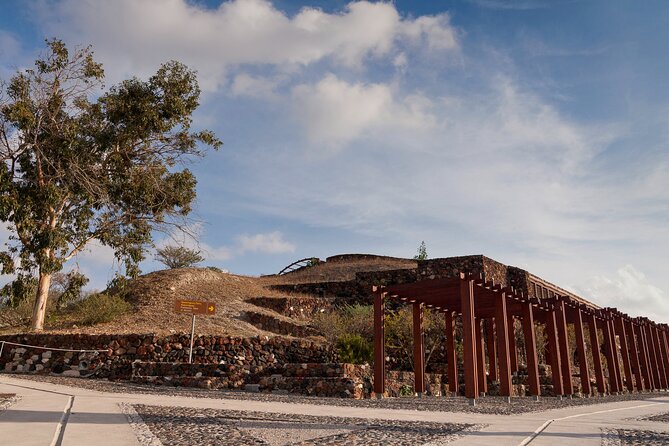
Akrotiri is often called the Greek Pompeii for a reason: a whole settlement got buried and preserved by a major natural disaster. In Santorini, that disaster was a volcanic eruption that covered the city in ash for thousands of years. What you see today is not random rubble. It’s a snapshot of a functioning place—streets, buildings, and artifacts that help you picture how people moved, worked, traded, and worshiped.
The big win of this private tour is that it helps you read the site. Without guidance, Akrotiri can feel like a set of walls and fragments. With Kostas, the same stone sections start to connect: where a household was likely organized, what certain objects suggest, and how the layout reflects planned living rather than chaos.
You’ll also get a storyline that holds together. You’ll move from what the excavation uncovered (pottery, furniture hints, even details tied to advanced plumbing) to what those discoveries imply about daily life. It’s history you can actually track as you walk.
You can also read our reviews of more guided tours in Santorini



Meeting at the Akrotiri entrance gate with a real orientation
The tour begins at the Akrotiri entrance gate in Mesaria 84700. The meeting point matters here because you’ll be able to buy the admission ticket and then meet the guide right at the site rather than figuring things out on your own.
Your first moment is a short orientation with Kostas—think quick orientation, what to expect inside, and how to approach the ruins so you don’t miss the key features. This is a small time block (about five minutes), but it’s one of the most practical parts of the experience. When you step into the excavations, you’ll already know what kind of evidence you’re looking for and which buildings or areas are meant to be understood as part of a bigger city.
If you’re the type who likes to ask questions, this is also where you can set the tone. Kostas adapts the visit to your group’s interests and pace, so that early setup helps your questions land better later.
Akrotiri’s Bronze Age city plan, daily life, and social order
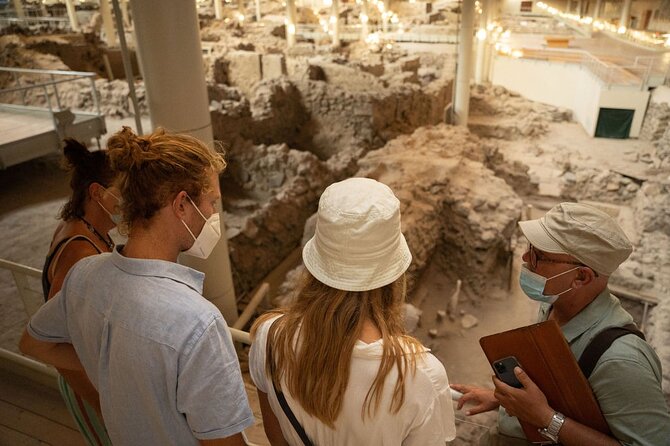
Once you’re inside, you’ll spend roughly 1 hour 15 minutes walking through Akrotiri with a guide who knows how to point out the why behind the what. The tour focus stays wide enough to feel like you’re seeing a complete settlement, but specific enough that you’ll remember details.
Here’s what you can expect your walk to cover:
- Urban planning and architecture: You’re not just looking at old walls. You’re learning how a Bronze Age city was organized. That means thinking about how space worked—how buildings relate to each other, and what the arrangement suggests about daily movement.
- Daily life, trade, and social organization: You’ll connect artifacts and building clues to how people likely lived and worked. The goal is to help you build a mental picture, not just collect facts.
- Pottery and material culture: You’ll see pottery described in context. Instead of treating it as decorative, the guide frames it as evidence—what it tells you about everyday activities and connections.
- Advanced plumbing systems: This is one of those details that can surprise you. When you hear about plumbing in a Bronze Age settlement, the site stops being only scenic and becomes impressive for practical reasons.
That practical feeling is the main value here. You end up with a sense of a real working place rather than an archaeological stop where you mostly look down and hope for the best.
Frescoes, religion, and the Atlantis connection
Akrotiri is famous for preserved art, especially frescoes. During your guided time, you’ll get explanations of fresco art themes and how they connect to religious practices and symbolism. This is where the tour often becomes more memorable, because you start noticing patterns: what themes show up, how symbolism might be read, and why those images mattered to the community.
Another thread you’ll hear about is the connection between Akrotiri and Plato’s story of Atlantis. Many people believe Atlantis was inspired by real events like a large catastrophe in the Aegean. In this tour, you’ll get the parallels explained in a way that helps you understand why the story stuck in the imagination—without turning it into a forced certainty. Even if you’ve never read Plato before, you’ll leave with a better sense of why Akrotiri became linked to Atlantis in the first place.
If you like myth, but you also like grounding it, this is a good balance. You’ll hear the cultural connection and then keep walking through the physical evidence that made Akrotiri so compelling to begin with.
Volcano ash preservation: why it matters when you stand there
One of the most important parts of the experience is learning why Akrotiri survived in such a legible way. The city was buried in volcanic ash, and that type of preservation is what gives you a rare window into Bronze Age life.
On this tour, the eruption story isn’t treated like a dramatic aside. It’s woven into what you see as you walk. When you understand the role of ash preservation, you start realizing that the site is different from typical ruins. You’re not only seeing collapsed structures—you’re seeing traces that help archaeologists reconstruct functions and routines.
This is also where Kostas’s guidance shines. A skilled guide helps you interpret what you’re seeing in the moment: which features suggest organization, which sections help tell a sequence of settlement and disaster, and how the preserved environment shapes what gets uncovered.
The tour ends inside the archaeological site, but you can keep exploring independently if you want more time at your favorite areas.
You can also read our reviews of more private tours in Santorini




Price and what you’re really paying for
The tour is priced at $240.59 per group (up to 4) for the private experience. On paper, that might look like a lot compared to joining a larger bus tour. Here’s how I’d think about value.
You’re paying for:
- A professional guide who can tailor explanations to your group’s interests
- A private pace, meaning you’re less likely to feel rushed through complex details
- A focused walk inside Akrotiri, where the guide’s interpretation does a lot of the heavy lifting
What’s not included changes the math. You’ll need to budget separately for:
- Admission ticket for Akrotiri (since it’s not included)
- All fees and taxes of €20 per person
- Food and drinks
- Hotel pickup and drop-off (you’ll handle getting to the entrance gate)
So the real value question is: do you want your time at Akrotiri to feel like a guided explanation of a city, or do you just want to wander among ruins? If you care about understanding the site’s meaning—urban planning, fresco themes, and practical tech like plumbing—this format is usually worth it. If you’d rather do a self-guided visit at your own pace, you might be happier spending less and reading your own way through the museum-style interpretation.
Booking ahead can also help. This experience is typically booked about 37 days in advance on average, so if you’re traveling in peak season, lock it in sooner rather than later.
Logistics that can make or break your visit
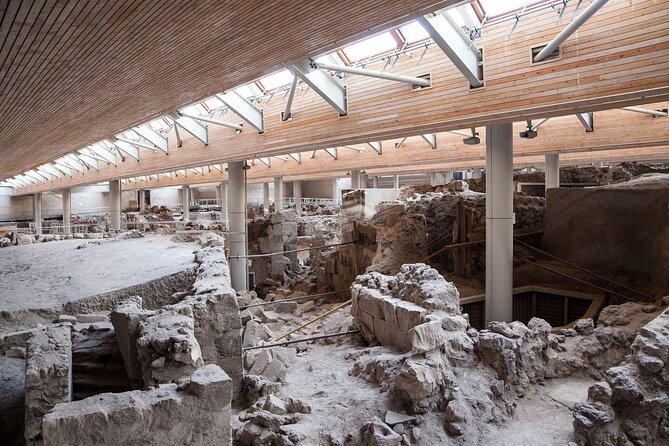
This tour is designed to be straightforward, but there are a few details you should plan around.
Meeting and end point: You meet at the Akrotiri entrance gate in Mesaria 84700, and the tour ends inside the archaeological site (it’s not a loop that returns you to the exact start spot). If you like to linger, that works in your favor—you can stay on and continue at your own speed after the guide wraps up.
Timing: The total tour time is about 1 hour to 1 hour 30 minutes. The short orientation sets you up for the longer guided walk through the excavations.
Mobile ticket: You’ll have a mobile ticket, which is usually easy to manage while you’re traveling.
Fitness and footwear: You should have a moderate physical fitness level. The ruins are outdoors and walking surfaces may be uneven, so I recommend sturdy shoes with grip.
Animals and transit: Service animals are allowed, and the meeting area is described as near public transportation. That helps if you don’t want to rely entirely on a car.
One extra note: if you’ve seen other types of Santorini activities advertised around the area (like horseback riding), make sure you pick the right experience. This tour is a guided visit focused on Akrotiri’s archaeological site. If your goal includes riding activities, you’ll need a separate option.
Who should book this private Akrotiri tour with Kostas?
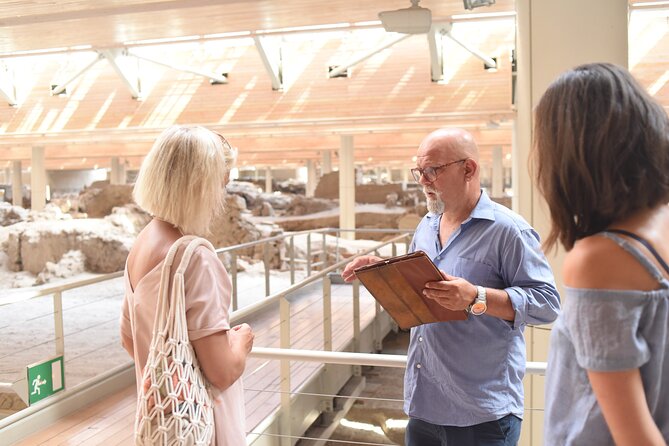
This private tour is a strong fit for you if you want more than a quick look. I especially recommend it if you fall into one of these groups:
- You love archaeology but want it explained in plain language.
- You care about how people lived—trade, social life, daily routines—not just big historical headlines.
- Your group includes a mix of interests (art, architecture, myth/Atlantis questions). Kostas covers all of these threads in one continuous walk.
- You want a smaller-group experience where you can ask questions and set the pace without feeling rushed.
If your group is very mobile-light or expects entirely flat walking, you might still enjoy it, but the moderate fitness note means you should plan for uneven ground and take breaks as needed.
Also, if you want a clean intro to Akrotiri’s big ideas—why it’s preserved, how the city was laid out, what frescoes mean—this is the kind of tour where you’ll feel your time add up quickly.
Should you book it?
Book this private Akrotiri guided tour with Kostas if your priority is understanding the site. The best reason to spend the money is that Akrotiri rewards interpretation. Kostas’s focus on key discoveries—pottery and furniture clues, advanced plumbing details, fresco themes, and the broader eruption-and-preservation story—turns the ruins into a readable city.
I’d skip or downgrade the tour if your goal is mostly photos and wandering with minimal context. In that case, a self-guided visit can work, and you’d save on the guided price. But if you want to walk away knowing what you just saw and why it matters, this private format is an efficient way to get it.
One final practical tip: budget for the site admission and the extra €20 per person in fees and taxes so you aren’t surprised at checkout. Once that’s handled, you can focus on the real value—learning how a buried Bronze Age city still tells its story today.
FAQ
How long is the private guided tour of Akrotiri?
It runs about 1 hour to 1 hour 30 minutes.
Is this tour private, and how many people are in a group?
Yes, it’s a private tour. Your group only participates, up to 4 people per group.
Is the Akrotiri admission ticket included in the price?
No. The admission ticket is not included, and you’ll need to purchase it separately.
What does the tour price include?
It includes a professional guide.
What’s not included besides admission?
Food and drinks are not included, and there are all fees and taxes of €20 per person. Hotel pickup and drop-off are also not included.
Where do we meet for the tour?
Meet at the Akrotiri entrance gate in Mesaria 84700, Greece.
Is the tour in English?
Yes, it’s offered in English.
What about cancellation?
Free cancellation is available up to 24 hours in advance for a full refund.