REVIEW · AUDIO TOURS
Authentic Santorini: A Self-Guided Audio Tour of Oia
Book on Viator →Operated by VoiceMap Audio Tours · Bookable on Viator
Oia rewards slow walking, and this route gives you the stories to match. This self-guided audio tour turns Santorini’s famous views into a connected walk, with GPS-triggered narration that follows your pace through Oia’s cliff paths and backroads.
I especially like the offline VoiceMap access (audio plus maps and geodata), which matters on a place where signal can be hit-or-miss. I also like how the narration is local in tone, delivered by a British woman with Greek roots, including a personal detail about her grandma being one of the few permanent residents left in Oia.
One thing to plan around: the walk can eat your time. If you start late and try to time it with the sunset crowds, you may not finish the whole loop.
In This Review
- Key highlights to know before you go
- Oia’s maze works better when audio runs the show
- Price and time: $7.99 that can buy you hours of value
- The practical start: where the tour begins and what you’ll need
- Stop by the Naval Maritime Museum and get Oia’s sea context
- Cliff-top pathways, hidden backroads, and the windmill area
- Picture-postcard views, plus ancient and recent-history storytelling
- Ekklisia Agioi Apostoloi church: a quieter island-paradise pause
- How volcanoes and earthquakes shaped Oia’s character
- Oia castle area and cave houses: where you’ll notice the past in stone
- Blue domes and the sunset crowd math you should do
- App experience: VoiceMap works best when you download first
- Who this self-guided walk fits best
- Should you book Authentic Santorini: A Self-Guided Audio Tour of Oia?
- FAQ
- How much does the Oia self-guided audio tour cost?
- How long is the tour?
- Is the tour available in English?
- What do I need to start the tour?
- Can I use the tour offline?
- Where do I start the tour?
- Where does the tour end?
- Does the tour include museum or attraction tickets?
- What’s the best time to do the walk?
- Is this a guided tour with a person?
Key highlights to know before you go

- GPS auto-play helps you stay on track, with prompts if you drift off route
- Offline audio + maps means you can keep going even when data is unreliable
- Picture-postcard stops are paired with “what shaped Oia” context, not just scenery
- Windmills, castle views, and cave houses show up along the route in a natural flow
- Churches as waypoints (including Ekklisia Agioi Apostoloi) give the walk breaks and variety
Oia’s maze works better when audio runs the show
Oia can feel like a beautiful maze. Streets tilt, steps snake, and every corner offers another view you want to stop for. The appeal of a self-guided format is that you control the pace, and the audio keeps the walk meaningful instead of turning it into random sightseeing.
This tour is built around a simple promise: you walk the core “Oia sights” circuit, but the narration ties it together with real context—how people lived here, and how nature literally shaped the village. You’re not stuck in a loud group or waiting for someone who moves at elevator speed.
Because it’s audio-led, it also helps you manage the most common Oia problem: too many viewpoints, not enough time. Even if you stop often for photos, the route is structured so you still get the main story beats.
You can also read our reviews of more guided tours in Santorini



Price and time: $7.99 that can buy you hours of value
At $7.99 per person, this is the kind of add-on that’s easy to justify. You’re paying for a guided route without paying for a guided group tour, and you’re getting lifetime access once you buy. That means you can replay it later if you come back to Santorini, or you can use it as a planning tool before your next trip.
Expect about 1 hour to 1.5 hours. That’s a good window for Oia. It’s short enough that you’re not trapped all afternoon, but long enough to hit windmills, blue domes, churches, and the castle area without feeling rushed.
The big practical trade-off: you need a smartphone and headphones. The tour includes the VoiceMap app and offline content, but your ears and device are on you.
The practical start: where the tour begins and what you’ll need

The tour starts near the Bus Stop to Fira on Unnamed Road, Oía 847 02, Greece. Your endpoint is near The Museum Project Oia (Nik. Nomikou, Oía 847 02, Greece).
You’ll want to arrive ready. The tour does not include your phone or headphones, so bring:
- A smartphone with the VoiceMap app installed
- Headphones (so you’re not broadcasting narration to the entire sidewalk)
- A quick plan to download content for offline use before you start walking
The tour is available essentially any time of day during the listed window (it’s shown as open 12:00 AM to 11:59 PM). That flexibility is nice, but in real life, your best time depends on crowds.
Stop by the Naval Maritime Museum and get Oia’s sea context

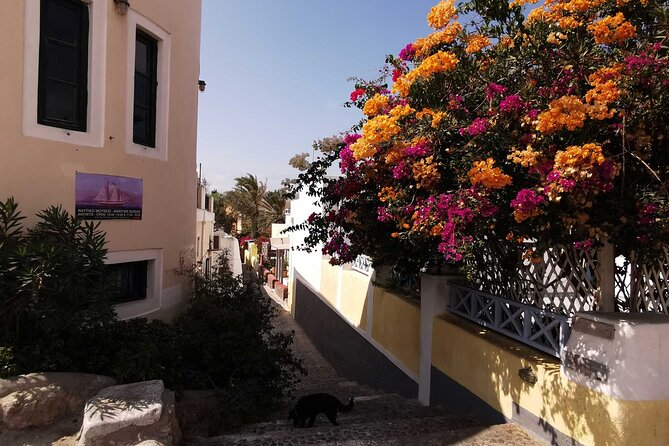
Early on, you’ll pass by and hear about the Oia Naval Maritime Museum. This is one of those smart moves that you often miss when you only chase views: you get a sense of Oia as a place shaped by the sea and life around it, not just a postcard.
What I like about starting with a museum-related waypoint is that it gives your brain a hook. When you later hear stories about how the village developed from a small settlement into a top destination, you’ll understand why the sea mattered in the first place.
This stop is not described as a ticketed museum visit. It’s presented as a pass-by audio moment, so treat it as orientation more than an entrance plan. If you’re hoping to do museum hours inside, you’ll need to plan that separately.
Cliff-top pathways, hidden backroads, and the windmill area

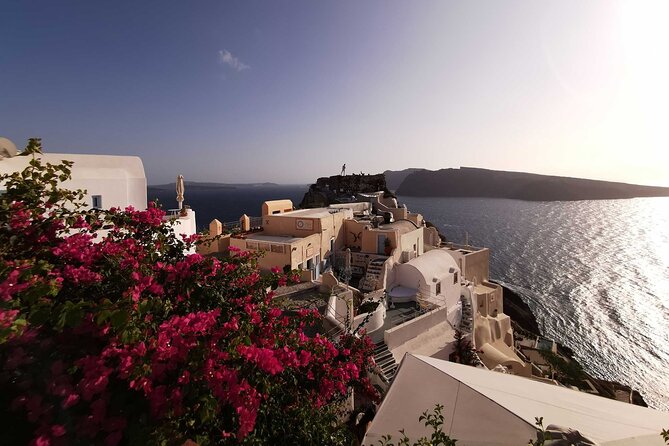
Then the route shifts into Oia’s signature walking style: cliff-top pathways and twists and turns that feel like they were designed for discovery. You’ll explore hidden backroads and get to see Oia’s famous windmills.
This is where the audio approach really earns its keep. If you try to self-navigate Oia from memory, you can end up looping without getting to the key sight clusters. The narration is designed to guide you through a place where the street layout can feel like a maze.
Also, windmills are not just “nice to photograph” here. The tour’s audio framing connects them to the village’s evolution and daily life. You’ll come away with a sense that these aren’t random decorative landmarks—they’re part of the living landscape that locals shaped over time.






Picture-postcard views, plus ancient and recent-history storytelling

As you continue, you’ll hit more classic Oia scenes—viewpoints that are popular because they look good instantly. But the tour adds value by including stories of both recent past and ancient history, so you’re not just staring at scenery.
You’ll see a couple of windmills again in the overall view sequence, plus other viewpoints that match what most people recognize when they think of Oia. The smart part is that the tour doesn’t treat each location like a standalone postcard. It keeps your attention on how the place got here.
A practical note: photo stops can stack up fast in Oia. Build in extra seconds, but don’t turn every overlook into a half-hour detour. If you do, sunset timing will start making decisions for you.
Ekklisia Agioi Apostoloi church: a quieter island-paradise pause
Next up is Ekklisia Agioi Apostoloi. Churches in Oia often function like natural wayfinding anchors: you see them from a distance, they break up the walking rhythm, and they give you a moment to breathe when everything else feels steep and crowded.
In the tour’s flow, this stop also works as a shift in perspective. Up to this point you’ve been chasing the “big view” rhythm. Here, the narration helps you slow down and absorb the island-paradise feeling without losing the history thread.
If you’re sensitive to crowds, pay attention to the time of day you do this part. The route includes some of Oia’s most sought-after scenery, and those areas can get packed when people start their sunset pilgrimages.
How volcanoes and earthquakes shaped Oia’s character

One of the most useful things the audio covers is how volcanic eruptions and earthquakes shaped Oia’s character and community. That kind of context is practical in a place like Santorini, where the built environment looks dramatic even if you know nothing about the geology.
When you understand that the landscape—and therefore the village form—was repeatedly reshaped, the rest of the walk starts clicking. You stop seeing the village as static, and you start viewing it as an ongoing adaptation.
This is also why the route works even if you’re not a hardcore history person. The narration keeps the story grounded in what you can see around you. You’ll hear about how locals lived here from a small settlement into today’s tourist hub, and why those events matter for the community’s feel.
Oia castle area and cave houses: where you’ll notice the past in stone
As you reach the castle area, the tour pairs history with a very physical experience: walking past cave houses. This is one of those moments where you’re not just getting a view, you’re getting evidence of how people built homes around the reality of the island.
Cave houses can look like they belong in a movie set, but they also make sense when you think about how communities survive. The tour helps you connect the dots between past living patterns and the environment that made those patterns practical.
The castle area is also where you’ll get that classic “Oia at a glance” feeling. If you’re the kind of traveler who likes to understand why a place looks the way it does, this section is a strong payoff.
Blue domes and the sunset crowd math you should do
Later, you’ll encounter blue-domed church views again in the route’s climax, and you’ll hear more about the stories tying recent and ancient history together.
This is the part of Oia where the sidewalk pressure can spike. The tour guidance in the real world is simple: start well before sunset if you want a real chance to complete the walk. The sunset crowds can get intense fast, and the route includes enough different scenes that time evaporates when you get stuck in a slow-moving line of photographers.
If your goal is to finish the full audio, I’d treat sunset as a bonus view, not a plan. Do the tour earlier, then if you still have energy, return later for a separate, calm sunset strategy.
App experience: VoiceMap works best when you download first
This tour runs through VoiceMap Audio Tours on Android and iOS, with offline access to audio, maps, and geodata included. That’s a big deal in Santorini because you may not always rely on strong mobile coverage.
In practical terms, the best setup is:
- Install the app before your walk
- Download the tour content so you’re not hunting for signal
- Put your phone in a comfortable spot you can glance at without stopping your flow too often
The route uses GPS-style tracking, and the app can auto-play the next track as you move. If you get off route, it should tell you when you’re off track. That reduces the mental load, which is what you want on a hilly maze of stairs and turns.
Who this self-guided walk fits best
This tour is ideal if you like:
- self-paced exploring
- history context without a formal group schedule
- hitting Oia’s major sights while still finding lesser-feel streets
- an audio guide that does the navigation work for you
It’s also a good fit for couples, solo travelers, and small groups who don’t want to coordinate with strangers. The format is private in the sense that only your group participates, even though you’re guiding yourselves.
If you hate walking on uneven ground or you need step-by-step reassurance for every turn, you may find Oia’s streets stressful. The tour is designed for most travelers to participate, but Oia itself is the real “fitness test,” not the audio.
Should you book Authentic Santorini: A Self-Guided Audio Tour of Oia?
I’d book it if you want to see Oia in a way that feels more than superficial. For $7.99, the combination of offline VoiceMap, a structured route through major landmarks, and stories that explain how Oia became what it is today is strong value.
Skip the idea if your number-one goal is to do a sunset-focused sightseeing spree with no walking discipline. This tour can be cut short by crowds if you start late, and the best results come from walking earlier in the day.
If you’re on the fence, here’s my quick decision rule: if you can commit to starting before the sunset crush, this is a smart way to get both views and context without paying for a traditional tour.
FAQ
How much does the Oia self-guided audio tour cost?
It costs $7.99 per person.
How long is the tour?
Plan on about 1 hour to 1 hour 30 minutes.
Is the tour available in English?
Yes, the audio tour is offered in English.
What do I need to start the tour?
You need a smartphone with the VoiceMap app and headphones. The tour does not include a phone or headphones.
Can I use the tour offline?
Yes. Offline access to audio, maps, and geodata is included.
Where do I start the tour?
The start point is at the Bus Stop to Fira on Unnamed Road, Oía 847 02, Greece.
Where does the tour end?
The tour ends near The Museum Project Oia, at Nik. Nomikou, Oía 847 02, Greece.
Does the tour include museum or attraction tickets?
No. It does not include tickets or entrance fees for museums or other attractions along the route.
What’s the best time to do the walk?
Going in the morning is recommended to beat crowds. Starting well before sunset gives you the best chance of completing the tour.
Is this a guided tour with a person?
No. It’s a self-guided audio tour using VoiceMap.