REVIEW · WALKING TOURS
Santorini: Walking Tour of Fira
Book on Viator →Operated by NST Santorini Tours · Bookable on Viator
Fira’s streets pack in a lot. This Santorini walking tour gives you a quick, guided feel for town life in Fira—then adds the fun factor of a round-trip panoramic cable car.
I like that it keeps the day practical: you cover major sights on foot without getting stuck in a museum schedule. I also like the variety, from churches and old religious buildings to local shops, art stops, and wine cellars along the way.
The one catch is that Fira can feel busy and crowded, and this is still a walking route with some stairs. If you’re sensitive to crowds or want a super-slow pace, plan to go in with patience and good shoes.
In This Review
- Key things to know before you go
- Meet at Ypapanti Thira and Start Smart
- Fira’s white cobblestones: Gold Street and the Venetian feel
- Saint John the Baptist and the Catholic layer of Fira
- Orthodox landmarks: Ypapanti’s big white church and the caldera edge
- Karavolades donkey roads and the mansions of Catholic nobles
- Cable car to the port: the view break you’ll actually use later
- Local ice cream tasting and the side stops that make it feel real
- Price and value: what $57 buys you in real time
- Who should book this Fira walking tour?
- Should you book this tour?
- FAQ
- Where is the tour meeting point?
- What time does the tour start?
- How long is the walking tour?
- How many people are in the group?
- What’s included in the price?
- Is lunch included?
- Are the church and landmark admissions included?
- Is the tour mobile-ticket based?
- What’s the weather requirement?
- Can I cancel for a full refund?
Key things to know before you go
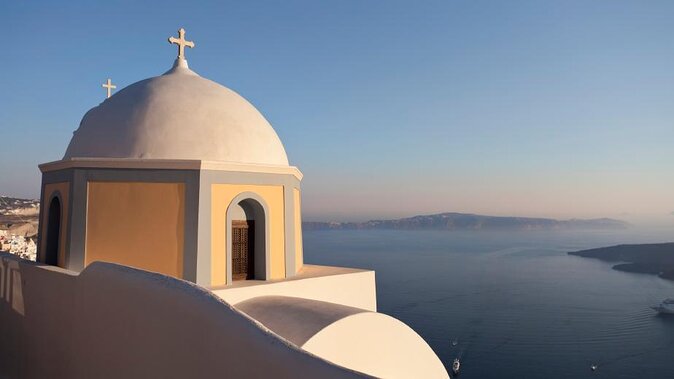
- Small group (max 16) keeps the walk from feeling like herding cats
- Round-trip cable car adds views and a fast way to reach the port area
- Church hopping covers both Catholic and Orthodox landmarks in one town
- Karavolades donkey roads give you a sense of how locals moved goods long ago
- Ice cream tasting is a simple, welcome break during the 3-hour loop
Meet at Ypapanti Thira and Start Smart
This tour starts at Metropolitan Church of Ypapanti ThiraIpapantis, in Thira (Fira) at 10:00 am. You’ll return back to the same meeting point at the end, so you’re not juggling transport or trying to figure out how to get back up the hill.
The main idea is that you’re doing a morning orientation walk. That matters on Santorini, because the island’s famous views are great—but Fira’s best energy is when you’re there early enough to move comfortably. The tour runs about 3 hours, which is long enough to see real street life, but short enough that you can still plan the rest of your day (beach time, Oia, or a slower afternoon coffee).
One practical note: the route assumes moderate physical fitness. Even though many stops are short, you’ll be on cobblestones and you’ll include a section of the famous donkey-road stairs (Karavolades). If your knees don’t love uneven stone, bring footwear with grip and give yourself a slower step pace.
Also, the tour uses a mobile ticket, so you’ll want your phone charged. If your battery is always low on travel days, consider an external battery so you aren’t stressed at the meeting point.
You can also read our reviews of more walking tours in Santorini



Fira’s white cobblestones: Gold Street and the Venetian feel
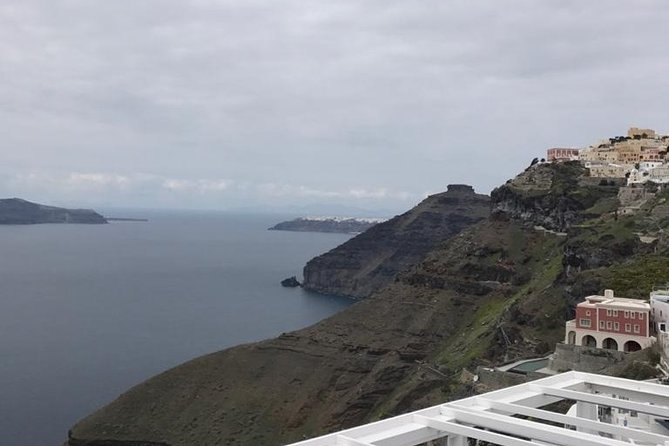
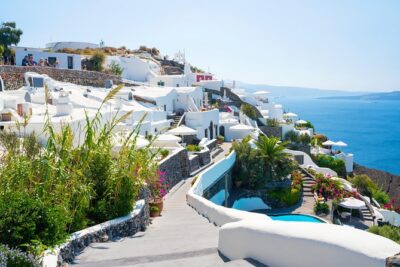
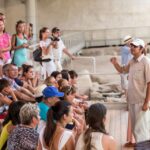
You begin with an hour walking through Fira’s classic maze of white cobblestone streets. This is the part where you quickly understand why people fall for Fira even if they don’t plan to stay there long. The town is compact, so the walk gives you a lot of “oh, that’s where we are” moments without requiring long transfers.
You’ll also pass through areas tied to older architectural influence, including what’s often described as the Venetian district. That’s a useful stop on a walking tour because it gives context for what you’re seeing—rather than you staring at buildings and guessing at the story behind them. It’s also where the town feels most “alive,” with storefronts and small-scale local business instead of big, single-purpose attractions.
What you’re really buying with this walking time is orientation. After this kind of walk, you usually know where to point if someone asks you where the caldera views start, which streets are easiest to cut across, and which areas feel more residential versus tourist-focused.
A drawback to flag: this is a shared walk. Fira is famous, so you may run into crowds at the church stops and viewpoints. That’s not a reason to skip it—it just means you should embrace the early start and expect some stopping-and-starting in the busiest spots.
Saint John the Baptist and the Catholic layer of Fira
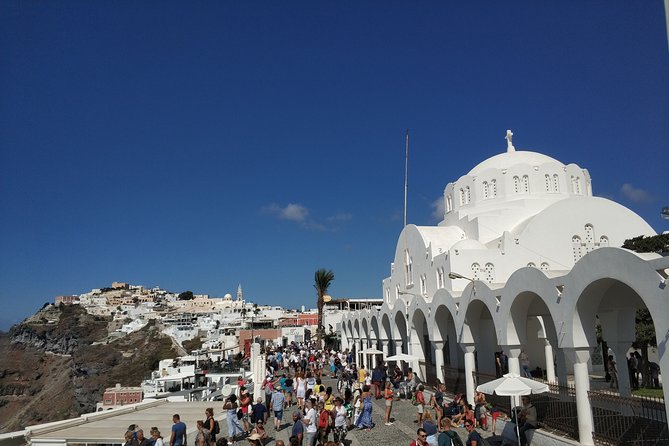
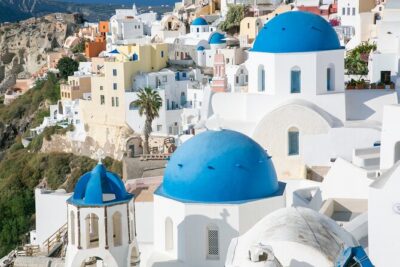
One of the most interesting parts is how the route doesn’t treat Fira as just one religious tradition. You’ll start with Cathedral of Saint John the Baptist, which includes the pink bell top you’ll spot from outside. You spend only a few minutes here, but it’s long enough to step inside and notice the monastery/church setting.
Right around this stop, you’ll also learn about the oldest Catholic nunnery in Greece, originally founded in 1595. That detail adds weight to what might otherwise feel like a quick photo stop. Even if you’re not big on church interiors, knowing that this is tied to a long-running Catholic presence makes the building feel less random and more meaningful.
Then the tour keeps moving, and that’s part of the value. You get a concentration of “signature” places without sitting through long visits. It’s a smart format for a short Santorini stay, especially if you’re trying to balance Oia, beaches, and caldera viewpoints with real time on the island.
What to consider: because time at each stop is brief, you’ll want to move with the group. If you prefer to linger, plan to do extra self-guided time later in the day—this tour is built for getting your bearings and seeing the highlights in order.
Orthodox landmarks: Ypapanti’s big white church and the caldera edge
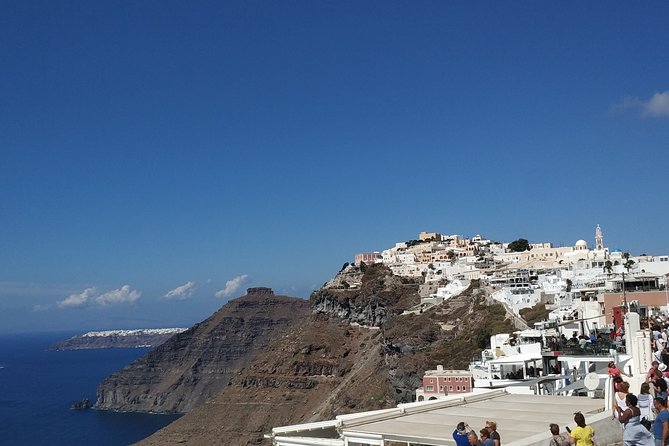
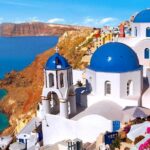
Next comes the Orthodox Metropolitan Cathedral, which is a trademark in Fira: a large white church sitting in front of the caldera view corridor. From a first-timer perspective, this helps you understand the visual language of the town. The Orthodox churches are often what you picture when you think of Greek island town squares and viewpoints, and this stop ties that look to an actual location in Fira rather than a distant postcard.
You’ll also hit other churches that anchor the religious map of the area, including Ekklisia Agios Minas, noted as one of the oldest churches in Fira. Again, these are short stops, but they’re useful because they keep the walk from becoming only “streets and photos.” You’re learning why these places matter locally.
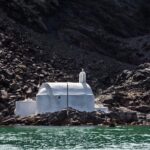
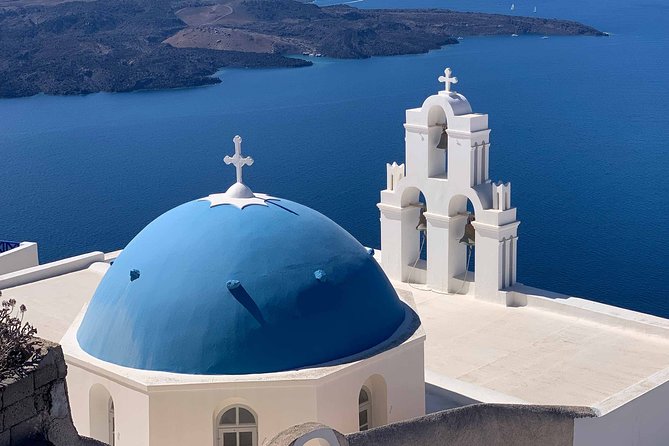
The route also includes a colorful church on the caldera. Even though you might not spend long inside (or in some cases at all), it’s still an important visual pause. Those bright church moments are what make Fira feel distinct from other Greek towns.
A practical point: these stops can be crowded because they’re central and photogenic. You’ll get better photos if you step aside for a minute instead of trying to fight for the exact center. Also, watch your footing. Church forecourts and the surrounding streets can be uneven, especially after a bit of foot traffic.
Karavolades donkey roads and the mansions of Catholic nobles
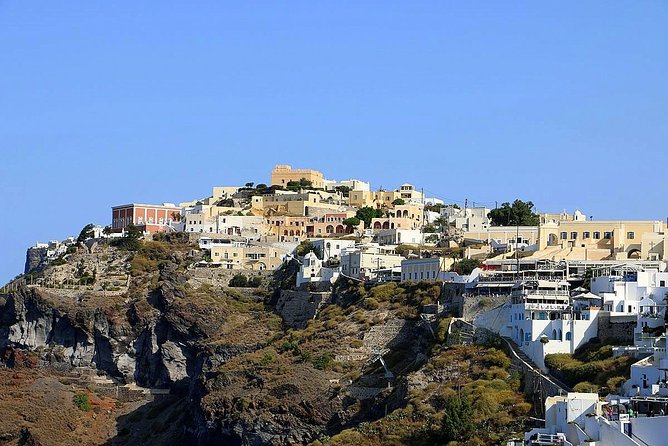
One of the most memorable “history-in-motion” stops is Karavolades Stairs. This is a short walk on a stretch of the famous donkey roads—routes locals used to carry goods. You might not realize it until you’re there, but those steep, practical paths are a big part of why Santorini towns look the way they do. It’s town planning shaped by the island’s cliffs.
From there, you’ll notice the tour shifting from “religious landmarks” into “how wealthy locals built and lived.” The route includes the Gyzi Megaron, described as one of the many mansions built by Catholic nobles in Fira from 1811 onward. Even if you only catch a quick exterior glimpse, this is a helpful anchor for understanding that Fira wasn’t always just a holiday backdrop. It was a real community with different social layers and architectural ambition.
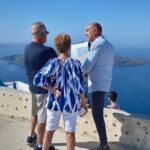
Then you’ll continue along the caldera edge in the middle of the walking flow, with enough stops to keep the story moving without turning the whole experience into a march of interruptions. The goal is to connect what you see—churches, stairways, mansion shapes—to why locals built there in the first place.
Consideration: if you’re expecting long guided lectures at each stop, this isn’t that. It’s fast, guided, and meant to keep you moving. If you love slow travel and deep site-time, you’ll want to follow up after the tour with a self-guided wander.





Cable car to the port: the view break you’ll actually use later
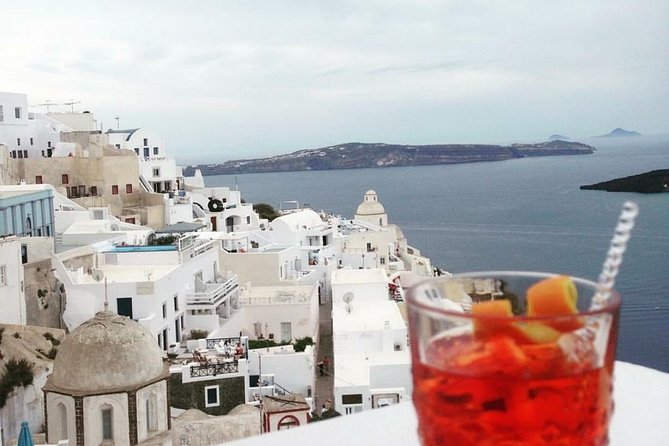
The tour includes a round trip cable car, and it’s timed as a quick panoramic break. You go down toward the port area and come back as part of the experience, so you’re not dealing with separate planning or transport decisions.
This is a great addition because the cable car does two things at once: it gives you a strong view down toward the waterline, and it saves you from walking the steep slope yourself. That matters when you’re already doing cobblestones and stairs.
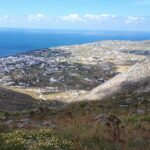
When it works best: if the weather is clear, you’ll feel the caldera’s dramatic shape immediately. If it’s hazy, you’ll still benefit from the change in perspective and the fact that you’re seeing how the port connects to the town.
One more practical detail: the cable car line and surrounding areas can be busy in peak times. Keep your group pace, stay aware of your belongings, and don’t get stuck waiting for perfect photo timing while everyone else is already moving.
Local ice cream tasting and the side stops that make it feel real
You get a local ice cream tasting included. It’s simple, but it’s also the right kind of included break—small enough to keep energy up, and specific enough to feel tied to the route.
Along the way, the tour also guides you past local workshops, art galleries, and wine cellars. Even if you don’t plan to buy anything, this is where the town feels less like a theme park and more like a working place. You see the kinds of businesses that survive because people arrive for the views and then spend time walking, snacking, and browsing.
About wine: the basic published inclusions focus on cable car and ice cream. Still, the route description references wine cellars, and some versions of this kind of Santorini walk may include a wine tasting at the end. If that’s important to you, check when you book so you don’t end up surprised.
Group size also affects your experience here. With a maximum of 16 people, you’re usually not stuck behind a huge crowd for the tastings and short viewpoint pauses. That’s a real value factor for a 3-hour tour: it keeps the vibe conversational instead of chaotic.
Price and value: what $57 buys you in real time
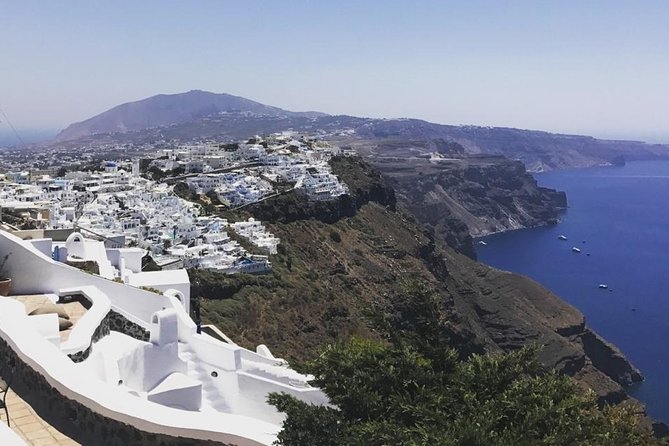
At $57.01 per person, this isn’t the cheapest thing you could do in Santorini—but it also isn’t trying to replace a full-day excursion. You’re paying for a concentrated package: guided highlights in Fira plus the cable car plus a tasting.
Here’s how I think about the value:
- You save time. Without a guide, you’d still walk these areas, but you might miss the “why” behind them.
- You get transportation built in through the cable car, which would otherwise take extra planning and time.
- You get structure. With multiple short stops, you’re less likely to wander aimlessly for three hours.
The main value-risk is expectation. If you expect lots of long stops, museum-depth time, or a slow, lounge-y experience, you may feel rushed. If you want a guided hit of Fira’s best-known landmarks plus a scenic cable car break, it’s a solid fit.
Also, this type of experience tends to get booked ahead. If you want a specific date, it’s smart to plan on reserving roughly a month in advance (the tour is often booked about 36 days ahead on average).
Who should book this Fira walking tour?
This is a strong choice if you:
- are spending only a short time on Santorini and want an efficient first look at Fira
- like your tours with a human guide who explains what you’re seeing in plain terms
- want a mix of churches, streets, and views, not just one kind of stop
- enjoy small groups and prefer a route that doesn’t drag on all day
It may not be your best match if:
- you hate crowds or need a very quiet pace
- you struggle with stairs and uneven cobblestones
- you want a more laid-back, slow wandering day with no set timing
Should you book this tour?
If you’re a “see it, learn it fast, then go explore” kind of traveler, I’d book it. The combination of Fira’s walking route, the cathedral-to-cathedral context, and the included cable car panorama gives you a lot of return for your time. The ice cream tasting is small, but it’s a nice reminder that this is about everyday island life, not just sightseeing.
If your priority is escaping crowds or you dislike any walking on stairs, consider shifting your expectations—or pairing this with a calmer plan later the same day. For many first-timers, though, this is a smart way to get oriented in Fira and understand how the town sits against the caldera.
FAQ
Where is the tour meeting point?
The tour meets at Metropolitan Church of Ypapanti ThiraIpapantis, Thira 847 00, Greece.
What time does the tour start?
The tour starts at 10:00 am.
How long is the walking tour?
The duration is about 3 hours.
How many people are in the group?
The tour has a maximum of 16 travelers.
What’s included in the price?
The price includes a round trip cable car and a local ice cream tasting.
Is lunch included?
No, lunch is not included.
Are the church and landmark admissions included?
The stops listed have admission ticket free, so you won’t need to purchase separate entry tickets for those specific sites.
Is the tour mobile-ticket based?
Yes, the tour includes a mobile ticket.
What’s the weather requirement?
This experience requires good weather. If it’s canceled due to poor weather, you’ll be offered a different date or a full refund.
Can I cancel for a full refund?
Yes. You can cancel up to 24 hours in advance for a full refund. If you cancel less than 24 hours before the start time, the amount paid isn’t refunded.