REVIEW · ISLAND HIGHLIGHTS & SIGHTSEEING TOURS
Santorini Private Sightseeing – Real Island Experience
Book on Viator →Operated by LAES | Bespoke Travel · Bookable on Viator
Sunset towns, volcanic stops, and real local time. This private Santorini day strings together the big-name views of Oia and the caldera with a run of Cycladic villages, beaches, and one major cultural stop, all guided by someone who tailors the pace to your interests. I especially love the pickup from your location and the way guide George brings Santorini to life with clear, practical context and smart recommendations. I also like how the route mixes must-sees with less-crowded-feeling areas so your time doesn’t vanish into the usual photo lines. One drawback to consider: the itinerary moves fast, with most stops clocking in around 10–30 minutes, so you’ll want to prioritize what you care about most before you arrive.
You’re not bouncing around in a shared shuttle—this is private transportation with an air-conditioned vehicle, bottled water, snacks, and complimentary Wi-Fi. You’ll also get a mobile ticket, and you can request high-res images afterward. If you’re the type who likes long, slow wandering in a single place, you may find this format a bit of a sprint. If you want a strong first look at the island (and a plan for what to do next), it’s a solid fit.
In This Review
- Key highlights of this Santorini private route
- A private day that actually helps you plan your trip
- Oia, caldera views, and Fira: your best orientation for first-timers
- Imerovigli’s balcony-to-the-Aegean mood (and why 20 minutes is enough)
- Pyrgos Kallistis and the monastery at Profitis Ilias: the higher side of Santorini
- Megalochori’s cobblestones and workshops: where the day feels local
- Akrotiri and the archaeological site: volcanic history in two parts
- Red Beach and the volcanic beach circuit: when Santorini turns physical
- Emporio’s castelli, windmills, and Santorini’s working island past
- Tomato museum to wind-and-sea finishes: a very Santorini-style twist
- Price and value: what $168.03 really buys you
- Logistics that matter: timing, tickets, and how to show up ready
- Should you book this Santorini private sightseeing?
- FAQ
- How long is the Santorini private sightseeing?
- What does pickup include?
- Is this tour private?
- What languages are available?
- Is admission included for all stops?
- Which admission fees are not included?
- What’s included in the tour price?
- Are group discounts available?
- Can I use a mobile ticket?
- Is there free cancellation?
Key highlights of this Santorini private route
- Oia + caldera viewpoints in focused, photo-friendly blocks, without losing the rest of the day
- George’s match-to-your-interests guidance, including follow-up ideas for other days
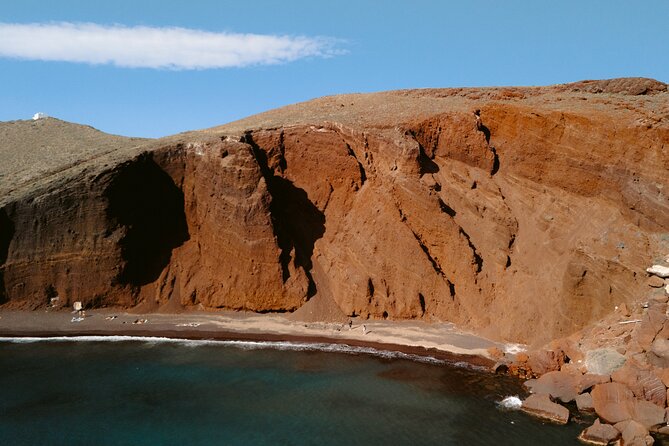
- Akrotiri area + Red Beach, two volcanic experiences that feel different from each other
- Cycladic village flavor at Pyrgos Kallistis, Megalochori, Emporio, and more
- A practical mix of stops: beaches, windmills, a tomato museum, and a monastery viewpoint
A private day that actually helps you plan your trip
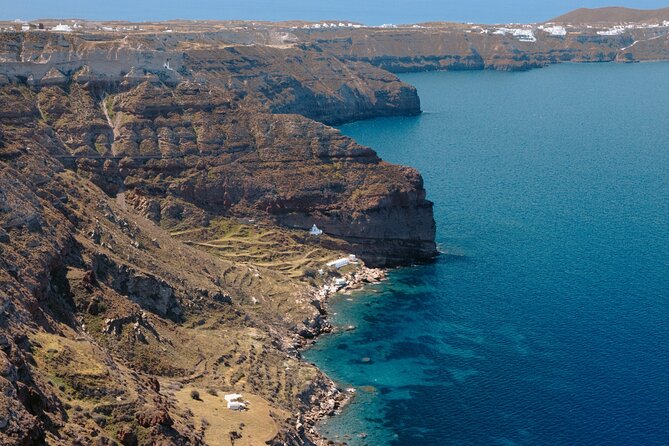
Santorini can feel like a choose-your-own-adventure puzzle. You’ve got cliffs, white towns, famous viewpoints, and then real local neighborhoods that don’t make it into the standard Instagram loop. This tour works because it’s built as a guided overview: you get a wide sweep of what the island does best, and the guide can steer you based on what you like—views, history, villages, or beaches.
The private format matters. With a shared tour, you often get stuck with the group’s timing. Here, the approach is more flexible in practice, because you’re moving as your party. You also get pickup and drop-off from preferred locations, so you’re not spending your limited vacation time coordinating trains of buses and taxis.
I also appreciate the steady “comfort basics” that keep the day from turning into a misery marathon. Air-conditioned transport helps on hot afternoons. Snacks and bottled water stop you from guessing whether you’ll find something quick. And the complimentary Wi-Fi and mobile ticket are the small conveniences that remove friction when you’re bouncing between towns.
The itinerary is packed—no sugarcoating that. Still, it’s not a random drive-by. The stops are chosen to group similar experiences: viewpoints together, village together, volcanic attractions together. That grouping is what turns a rushed schedule into something that feels coherent.
You can also read our reviews of more private tours in Santorini


Oia, caldera views, and Fira: your best orientation for first-timers

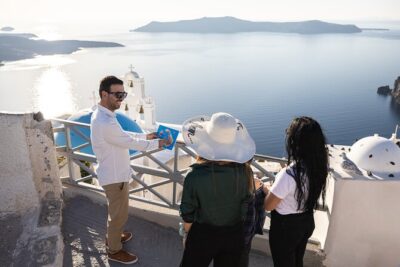
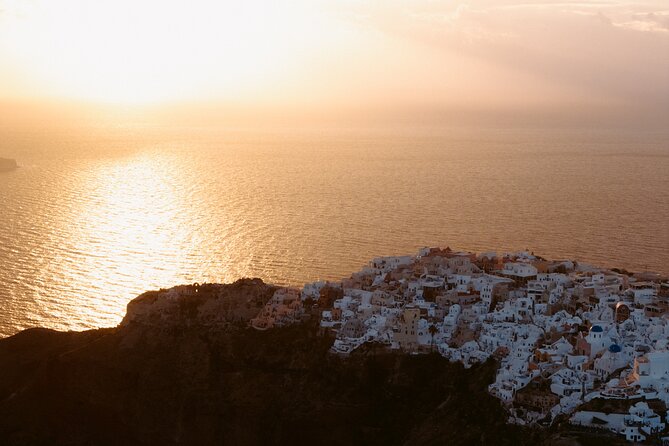
You start in Oia, one of Santorini’s signature postcard towns. The time here is tight—about 30 minutes—but it’s enough to get your bearings: whitewashed buildings, the classic blue-domed churches, and those dramatic cliffside views that make Oia famous. If you’re the type who cares about the “why” behind a place, this is a good first stop because your guide can frame what you’re looking at.
From there, you head to caldera viewpoints for about 20 minutes. This is where Santorini stops being just pretty and starts becoming geological. Expect cliffside panoramas and the volcanic character of the island—the kind of view that makes you understand why locals built their lives around the rim of a crater-like sea.
Then it’s on to Fira, the island’s capital. You’ll get roughly 30 minutes, which is perfect for a quick orientation loop: panoramic caldera views, plus a mix of shops and cafes if you want a snack or a short browse. Just keep expectations realistic. In this time window, you’re not doing deep shopping or settling into a café for hours. You’re sampling the vibe and getting photos from the right angles.
If you’re visiting during peak season, this section of the island can be visually impressive but crowded. The trade-off is that Fira and Oia are also where you can most quickly understand Santorini’s layout: where the caldera faces, how towns step down the cliffs, and why getting around often feels like a series of stair-and-sun angles.
Practical tip: bring sunglasses and sun protection. Even when the day starts mild, those cliff viewpoints amplify the light.
Imerovigli’s balcony-to-the-Aegean mood (and why 20 minutes is enough)
After Fira, you’ll shift to Imerovigli for around 20 minutes. This is an elegant, calmer-feeling stretch compared with the heaviest tourist corridors, and it’s often called the balcony to the Aegean. It’s also known for upscale hotels and a lively bar scene, so the area has that polished, evening-ready feel.
In a short stop like this, the main goal is viewpoint time. You’re there to absorb the scale of the caldera and see Santorini’s cliff towns from a different angle than Oia and Fira. That shift matters. The island is dramatic from multiple sides, and you’ll start to notice patterns—how viewpoints frame the water, where the cliff curves, and how towns sit like terraces.
One consideration: because it’s a short stop, you may not get time for a long, meandering walk. If you love long strolls, think of Imerovigli as a “get the view and move” stop. If you love photography, this is a good place to focus.
Pyrgos Kallistis and the monastery at Profitis Ilias: the higher side of Santorini
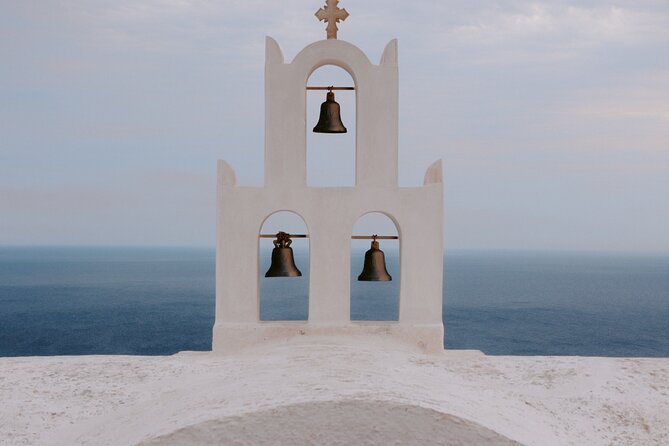
Next up is Pyrgos Kallistis, the old capital area. You’ll have about 30 minutes. This is classic Cycladic village territory: traditional architecture, calm streets, and panoramic views that feel a bit more grounded than the cliff-edge superstar spots. It’s also the kind of stop where you can slow your pace for a moment without feeling like you’re missing the whole island.
Then you’ll go to the Monastery of Profitis Ilias, roughly 20 minutes, located at Santorini’s highest point. The reward here is viewpoint access. From higher ground you get a wider view of the island’s shape and the way the caldera rim cuts the sea. The monastery stop also gives you variety in the day—religious architecture and a high vantage point, not just streets and beaches.
What to expect in terms of effort: in areas like this, you may find some stairs or uphill walking depending on where the vehicle drops you. It’s not described as a full hike, but you should plan to handle some uneven steps and short uphill segments.
If your goal is to understand Santorini beyond the shoreline, these two stops do that job. You see the island’s layers—coast, towns, then the heights.
Megalochori’s cobblestones and workshops: where the day feels local
Megalochori is about 30 minutes and is built for people who like the island without the constant “tour pass” feeling. You’ll see whitewashed houses, scenic vineyard areas, and cobblestone streets. It also has art galleries, handmade shops, and local workshops where craft and everyday life show up in the details.
This stop is a nice counterweight to the earlier viewpoint sections. By the time you arrive, you’ve already spent time looking outward. Megalochori helps you look inward—at the way Santorini culture actually occupies space: small streets, craft stores, and that slower village rhythm.
A practical note: the time is short, so treat this as exploration time rather than shopping time. If you want to buy something handmade, be ready to decide quickly, because you won’t have a long, uninterrupted window to compare every shop.





Akrotiri and the archaeological site: volcanic history in two parts

Akrotiri is famous for its dramatic volcanic scenery and for what it represents culturally. You get a brief scenic stop (about 15 minutes) plus time at the Akrotiri archaeological site for about 30 minutes. This is the one major ticketed component that isn’t included—admission to the archaeological site is not part of the tour price.
That separation is important for planning. If you’re an archaeology fan, you’ll likely want to set aside enough mental space for the site visit. If you’re more into views and beaches, you can still enjoy the Akrotiri area, but the archaeological site is the real payoff for the history-minded.
Also note that the tour includes other admission at several stops, so it can feel seamless across the day. But Akrotiri Archaeological Site is explicitly not included, so budget for that extra ticket if it matters to you.
Red Beach and the volcanic beach circuit: when Santorini turns physical
Red Beach is one of those places that makes Santorini feel like a real landscape in the literal sense: red cliffs, clear water, and a dramatic contrast between geology and the sea. You’ll get about 20 minutes here, and admission is included.
This is a good stop for photos and a quick swim break if conditions allow, but don’t plan on lounging for an hour. The timing is built for moving between experiences. Wear shoes you can handle on rocky or uneven beach edges, and consider bringing a towel you’re comfortable getting sandy.
After that comes a shift toward other beach textures. Vlychada Beach is about 10 minutes and is known for its moon-like scenery, framed by white volcanic cliffs and calmer waters. Then Perivolos Beach is about 20 minutes, with black volcanic sand and a warm, soothing feel described as mineral-rich.
Taken together, these beaches show the volcanic “family resemblance” across the island—different colors, different vibes, same geological origin. It’s the kind of sequence that helps you remember Santorini as more than towns on cliffs.
Emporio’s castelli, windmills, and Santorini’s working island past

You end up in Emporio areas with about 30 minutes at Castelli of Emporio. This is an older village feel, with narrow streets, old churches, Cycladic architecture, and an emphasis on local life away from the most crowded routes. It’s also home to the oldest church on the island and includes a historic castle.
Then you’ll see the Windmills of Emporio for about 30 minutes. These windmills date back to the 14th century and were used to grind wheat and barley into flour. The structures are described as about 6 meters tall and around 30 meters in circumference, and they include mills, ovens, storage rooms, and animal barns. Some are also dug into the earth to avoid blocking wind. That’s the kind of detail you don’t get from a quick photo stop.
This section of the day adds depth. Instead of only seeing what Santorini looks like today, you see how people once processed food, stored goods, and used wind. If you like places with practical history—how life worked here—Emporio and the windmills deliver.
Tomato museum to wind-and-sea finishes: a very Santorini-style twist
One stop that breaks up the usual sightseeing rhythm is the Tomato Industrial Museum, D. Nomikos. You’ll have about 30 minutes, and admission is included. It was established in 1945 and focuses on the history, machinery, and culture behind Santorini’s famous tomatoes.
This is a surprising but genuinely useful stop if you want to understand why Santorini isn’t just scenery. Agriculture and production are part of the island’s identity, and a tomato museum is an easy way to connect the dots between everyday life and what visitors rarely notice.
Then the day wraps through the beach circuit and back out. Vlychada and Perivolos give you different beach textures and a final contrast between cliff shapes and sea time. It’s a nice way to land the tour: geology, village life, working history, then sand and water.
Price and value: what $168.03 really buys you
At $168.03 per person, this is not a budget deal. But it’s priced like a true private guided experience, with several value points built in: pickup and drop-off, a private air-conditioned vehicle, concierge-driven travel, snacks, bottled water, complimentary Wi-Fi, and all fees and taxes included.
The big question is what you’ll compare it to. If you’re used to paying extra for guides, transport, and each attraction individually, this becomes easier to justify. Also, this is the kind of tour that saves you from the mental overload of planning. You don’t have to decide which viewpoints come first or how to group stops efficiently across the island’s cliff roads.
Two also-for-real value notes:
- Group discounts are listed as available, so the per-person value can improve with more people in your party.
- Most stops have admission included or marked free, which reduces the pile of small add-ons that can add up during a day like this.
One more consideration: the itinerary time windows are short. That’s part of the design. You’re buying coverage and planning fuel, not hours of time for a single museum or a slow, sit-down meal in each town.
Logistics that matter: timing, tickets, and how to show up ready
Most days run about 4 to 8 hours. On average, it’s booked around 13 days in advance, which tells you demand is real—especially in peak season.
A few practical pointers so you get the most out of the day:
- Decide your top 3 priorities before pickup. If you love beaches, focus on those stops. If you care about villages, prioritize Megalochori and Emporio. If history matters, don’t skip planning for Akrotiri’s archaeological ticket.
- Wear comfortable shoes. Even short stops on Santorini often mean stairs, curbs, and uneven surfaces.
- Bring sun protection. You’ll be exposed during viewpoints and beach time.
- Ask your guide for a follow-up plan. George’s recommendations for other days showed up as a standout in real experiences: he doesn’t just point at places, he helps you build a next-step itinerary.
If you’re arriving via a cruise, note that cruise guests’ cable car fare is not included. That detail can affect how you time the day and how you plan your movement between zones.
Should you book this Santorini private sightseeing?
Book it if you want a guided “first pass” through Santorini—views, villages, beaches, and one major cultural stop—without needing to design a route from scratch. It’s especially good for people who like the idea of learning as they go, and for anyone who values the guide’s ability to adjust to your interests.
Skip it or choose a different style if you’re the type who wants long stays in one place, or if you dislike fast transitions. The tour is built for coverage. You’ll get a lot in a single day, but you won’t live like a local in just one neighborhood.
If you do book, I’d treat the day like a planning tool. Use it to learn where you want to return later, then spend your extra time choosing your favorite cliff, beach, or village for a slower round.
FAQ
How long is the Santorini private sightseeing?
The tour runs about 4 to 8 hours.
What does pickup include?
Pickup is offered from all preferred locations and is included in the service, with drop-off at every location.
Is this tour private?
Yes. It’s private, and only your group participates.
What languages are available?
The tour is offered in English.
Is admission included for all stops?
Not for every stop. Some stops are free, some have admission included, and the Akrotiri Archaeological Site admission is not included. Red Beach and several other stops list admission as included.
Which admission fees are not included?
The Akrotiri Archaeological Site admission is not included. If you’re a cruise guest, the cable car fare is also not included.
What’s included in the tour price?
The tour includes concierge-driven travel, private transportation, pickup and drop-off, complimentary Wi-Fi, air-conditioned vehicle, snacks, bottled water, mobile ticket, and high-res images upon request, plus all fees and taxes.
Are group discounts available?
Group discounts are listed as a feature.
Can I use a mobile ticket?
Yes, a mobile ticket is provided.
Is there free cancellation?
Yes. Free cancellation is available up to 24 hours in advance for a full refund.